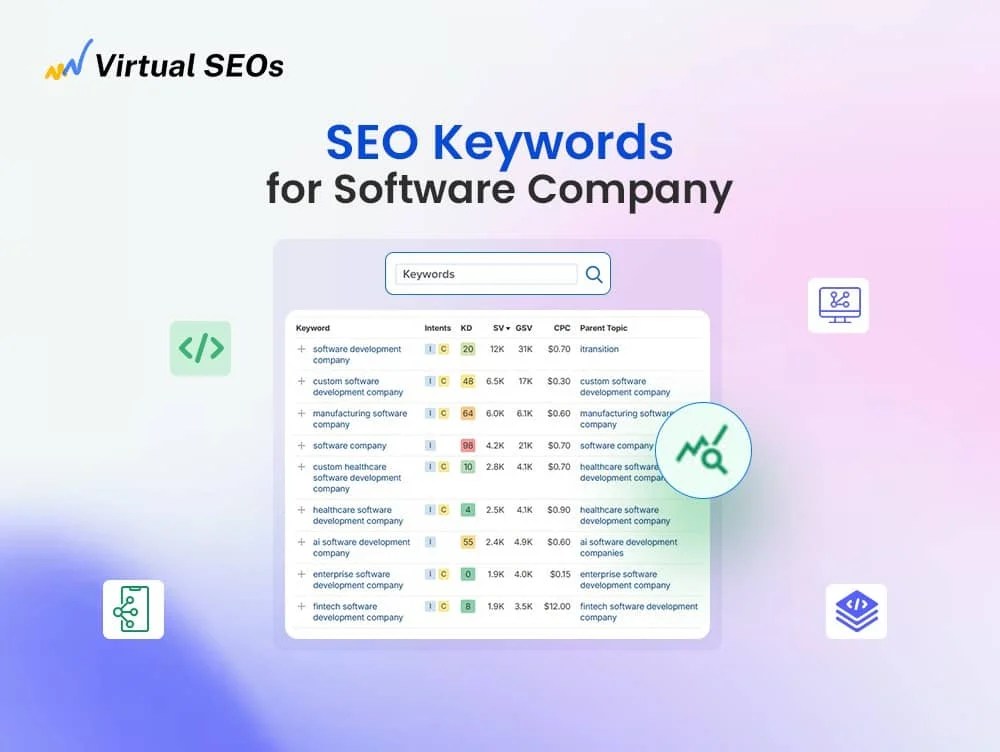
SEO Keywords for Software Company

Written By
Tanbir Masum
Last Updated
April 20, 2026
Time to Read
9 min
Share
Software companies nowadays started depending on referrals which is called single channel dependency. This brings you clients but it’s definitely unstable because referrals slow down leads also.
At the same time potential customers search on google every day for software solutions. If your business is not showing up there then you miss a thousand chances and this is exactly where SEO stands out.
Those organic searches from your potential clients can give you many opportunities. SEO also brings steady traffic, builds trust and works long term without paid ads. Gfs
This guide is dedicatedly written for software agencies, SaaS companies and IT first and you will learn how to find and use the right SEO keywords to grow your businesses.
Get Your Free Keyword Research Consultation!
Why SEO Keyword Strategy Is Different for Software Companies
Software buyers initially spend a lot of time on researching before making any purchase. They compare tools, pricing, features, read reviews, watch videos and read blogs. Search engine optimization help you reach them early even before they are ready to buy
The sales cycle is longer because potential software buyers do not purchase quickly. So your content must target all 3 steps of the sales funnel.
TOFU/Top of Funnel (Awareness): Top of the funnel or awareness stage is the position for a potential customer where they know they have got a problem but dont have solutions so they start searching for solutions on the internet. In this stage, potential customers don’t know your agency or the solution you provide.
MOFU/Middle of Funnel (Consideration): In the middle of the funnel stage, those customers understand their problems and look for solutions and read blogs, articles, watch videos etc. they use keywords like CRM software, project management tools etc.
BOFU/Bottom of Funnel (Decision): Finally in this stage they become ready to choose a product or software solution provider and they may try keywords like HubSpot vs Salesforce, best CRM software pricing, XYZ software reviews etc.
There are also key differences: SaaS companies SEO is focused on product-led keywords, software agencies SEO is targeted on the service-based searches and IT services SEO is focused on solutions and support.
Software companies also face a challenge because many companies use technical words, but buyers search in simple language, so matching this gap is very important.
Almost 78% or more business-to-business buyers start finding solutions with initial searching with google.
Types of SEO Keywords Every Software Company Needs
To build a strong pipeline, software companies need more than just general industry terms. A good strategy uses main types of keywords, each serving a different purpose.
1. Short-Tail Keywords
Short-tail keywords are broad in terms of meanings, general phrases with one or two words sometimes can be a maximum of three words as well. Short tail keywords have high high search volume and this can attract many visitors. This type of word has a solid competitor base.
Here are a few examples of short-tail keywords to help you understand the type of broad phrases your software company should target.
Example:
| Keyword | Volume | Difficulty | Intent |
| software development | 60000 | High | Informational |
| SaaS software | 25000 | High | Informational |
| CRM software | 90000 | Very High | Commercial |
| ERP software | 40000 | High | Commercial |
| IT services | 30000 | High | Commercial |
| cloud software | 20000 | High | Informational |
| business software | 15000 | High | Commercial |
| enterprise software | 18000 | High | Commercial |
| workflow automation | 12000 | Medium | Informational |
| project management software | 120000 | Very High | Commercial |
Use these on your homepage and main service pages. They are for visibility and brand recognition, not immediate sales.
2. Long-Tail Keywords
Long tail keywords are longer phrases than short tail keywords because they include a minimum of four words or more than that. For long tail keywords the most interesting matter is those searches are specific and they know what they want. Long tail keywords have a lower search volume but conversion is higher compared to other keywords.
To give a better idea, here are some long-tail keywords that target users looking for specific solutions.
Examples:
| Keyword | Volume | Difficulty | Intent |
| custom software development for startups | 1500 | Medium | Commercial |
| best CRM software for small business | 3000 | Medium | Commercial |
| how to build a SaaS product step by step | 1000 | Low | Informational |
| affordable software development company | 800 | Medium | Commercial |
| hire remote software developers | 2000 | Medium | Transactional |
| custom ERP software development company | 700 | Medium | Commercial |
| SaaS product development for startups | 600 | Medium | Commercial |
| software development company for small business | 900 | Medium | Commercial |
| cost to build a mobile app in 2026 | 1200 | Medium | Informational |
| offshore software development services | 1000 | Medium | Transactional |
Use these in blog posts and help articles. They capture users looking for answers to specific problems.
3. Local SEO Keywords
Local SEO keywords are one of the most important keywords among others. Because they are words that target potential customers from specific locations, regions or areas. Potential customers search with nearby keywords or including area or or landmarks name.
For a better picture, here are examples of local SEO keywords software companies might use to attract nearby clients.
Examples:
| Keyword | Volume | Difficulty | Intent |
| software company in London | 2200 | High | Commercial |
| software development company UK | 3000 | High | Commercial |
| SaaS development agency Germany | 1200 | Medium | Commercial |
| software company in Berlin | 900 | Medium | Commercial |
| mobile app developers in Dubai | 2500 | High | Commercial |
| software company in UAE | 1800 | High | Commercial |
| IT outsourcing company Europe | 1000 | Medium | Commercial |
| software development company France | 1500 | Medium | Commercial |
| software agency in Netherlands | 800 | Medium | Commercial |
| software company in Saudi Arabia | 1300 | Medium | Commercial |
| IT consulting company Switzerland | 700 | Medium | Commercial |
| SaaS company in Sweden | 600 | Medium | Commercial |
| mobile app development company Qatar | 900 | Medium | Commercial |
| software company in Ireland | 1000 | Medium | Commercial |
| IT services company Norway | 500 | Medium | Commercial |
Optimize your Google Business Profile and create location-specific pages to capture city-based searches.
4. Intent-Based Keywords
Intent-based keywords are focused on the user’s goal or target behind the search. Those keywords indicate a potential client’s funnel stage or more clearly are they learning, comparing options or ready to purchase. You understand those intent based keywords then you can create content for your software company according to those keywords.
Here’s a simple table showing examples of intent-based keywords and the stage of the buyer’s journey they target.
| Intent Type | Keyword | Volume | Difficulty |
| Informational | what is SaaS software | 4000 | Low |
| Informational | how does cloud software work | 2000 | Low |
| Navigational | HubSpot login | 20000 | Low |
| Navigational | Salesforce pricing page | 15000 | Low |
| Commercial | best project management tools | 8000 | Medium |
| Commercial | top CRM software for startups | 3000 | Medium |
| Transactional | hire software development company | 2500 | Medium |
| Transactional | get custom software quote | 1000 | Medium |
| Transactional | book software consultation | 800 | Medium |
Use comparison pages, case studies, and product pages to target commercial and transactional searches so your company shows up when buyers are ready to purchase.
5. Competitor & Comparison Keywords
Competitor & comparison keywords are phrases that mention competing products or services. Those keywords are used for high intent because of the users mindset of already considering purchasing and comparing features, pricing or brands.
To make it clearer, here are some examples of competitor and comparison keywords software companies use.
Example:
| Keyword | Volume | Difficulty | Intent |
| HubSpot vs Salesforce | 6000 | High | Commercial |
| Jira vs Trello comparison | 5000 | Medium | Commercial |
| best CRM software comparison | 3000 | Medium | Commercial |
| Shopify vs custom website | 2000 | Medium | Commercial |
| Slack alternatives for business | 4000 | Medium | Commercial |
| Asana vs Monday.com | 3000 | Medium | Commercial |
| Zoho CRM vs HubSpot | 2000 | Medium | Commercial |
| best SaaS tools for startups | 2500 | Medium | Commercial |
| top ERP software comparison | 1500 | Medium | Commercial |
| ClickUp vs Notion | 4000 | Medium | Commercial |
You can write comparison content, blog posts, articles etc to capture users intention about what they are looking for. Those types of keywords are very potential for conversion.
6. Industry-Specific Keywords
Industry specific keywords are phrases that target a specific niche/sector of industry. Using those industry specific keywords helps software companies find clients from the industry that you work with. Those keywords are very potential about bringing leads and converting them into customers.
For a better idea, here are examples of industry-specific keywords.
Example:
| Keyword | Volume | Difficulty | Intent |
| healthcare software development company | 1000 | Medium | Commercial |
| fintech app development services | 900 | Medium | Commercial |
| real estate management software | 2000 | Medium | Commercial |
| eCommerce software solutions | 3000 | High | Commercial |
| logistics software development | 700 | Medium | Commercial |
| education software development company | 800 | Medium | Commercial |
| hotel management software system | 1500 | Medium | Commercial |
| insurance software solutions | 600 | Medium | Commercial |
| HR management software system | 2000 | Medium | Commercial |
| supply chain software development | 700 | Medium | Commercial |
Use these on service pages, blog posts, and landing pages focused on specific industries. They help attract qualified leads who need software for their niche.
Top SEO Keyword Categories for Software Companies
If you run a software company, targeting those types of keywords are essential. Because they match your potential customers’ intent, required services, products, tech stack according to location or special requirements. Let’s talk about some categories that represent the SEO keywords categories for software companies the best.
1. Software Development Keywords
Software development keywords are phrases that focus on core software services. They help software companies attract clients looking for custom solutions, enterprise tools, or MVP development.
For a better idea, here are examples of software development keywords.
Example:
| Keyword | Volume | Difficulty | Intent |
|---|---|---|---|
| custom software development services | 5000 | High | Transactional |
| enterprise software development | 3000 | High | Commercial |
| software development company | 8000 | High | Commercial |
| outsource software development | 2000 | Medium | Transactional |
| full stack development services | 2000 | Medium | Commercial |
| agile software development company | 1000 | Medium | Commercial |
| MVP development services | 1500 | Medium | Transactional |
| dedicated software development team | 1200 | Medium | Transactional |
| product development company | 1000 | Medium | Commercial |
Software development related keywords are ideal for your website’s service page, blog posts and landing pages. These types of keywords help drive potential clients looking for these solutions.
2. Mobile App Development Keywords
Mobile application development keywords are targeted on clients looking for iOS, Android, or cross-platform apps (Flutter). Those keywords help software companies reach users who need mobile application solutions for their business.
For a better idea, here are examples of mobile app development keywords.
Example:
| Keyword | Volume | Difficulty | Intent |
|---|---|---|---|
| mobile app development company | 6000 | High | Commercial |
| iOS app development services | 2500 | Medium | Commercial |
| Android app developers for hire | 2000 | Medium | Transactional |
| Flutter app development agency | 1200 | Medium | Commercial |
| cross platform app development | 1500 | Medium | Commercial |
| React Native app development company | 1800 | Medium | Commercial |
| app development cost estimate | 2000 | Medium | Informational |
| hire mobile app developers | 2200 | Medium | Transactional |
Use these on mobile app service pages, blogs, and portfolio sections. They help attract clients evaluating app development services.
3. SaaS Keywords
SaaS keywords are dedicatedly focused on cloud based software products and solutions. They help software companies bring business or clients looking to build or adopt SaaS platforms or tools. Those types of keywords are known for their highly potentiality of conversion.
For a better idea, here are examples of SaaS keywords.
Example:
| Keyword | Volume | Difficulty | Intent |
|---|---|---|---|
| SaaS development company | 2000 | Medium | Commercial |
| build SaaS application | 1000 | Medium | Informational |
| SaaS product development services | 900 | Medium | Transactional |
| cloud-based software solutions | 3000 | High | Commercial |
| SaaS platform development | 1200 | Medium | Commercial |
| multi-tenant SaaS architecture | 700 | Medium | Informational |
| SaaS startup development company | 800 | Medium | Commercial |
| scalable SaaS solutions | 600 | Medium | Commercial |
You can use these on product pages, SaaS blogs, and whitepapers. They help attract decision-makers looking for cloud-based software solutions.
4. Technology Stack Keywords
Technology stack keywords highlight programming languages, frameworks, or tools your company uses. Tech stack keywords help you attract clients who need experts in specific technologies.
For a better idea, here are examples of technology stack keywords.
Example:
| Keyword | Volume | Difficulty | Intent |
|---|---|---|---|
| hire React developers | 3000 | Medium | Transactional |
| Python development company | 2000 | Medium | Commercial |
| Node.js development services | 1500 | Medium | Commercial |
| Laravel development agency | 1000 | Medium | Commercial |
| Java development company | 2000 | Medium | Commercial |
| .NET development services | 1800 | Medium | Commercial |
| Angular development company | 1200 | Medium | Commercial |
| full stack JavaScript developers | 1500 | Medium | Transactional |
The best place to use these on tech stack pages, developer profiles, and technical blogs. They help attract clients looking for specific technology expertise.
5. Industry-Specific Software Keywords
Industry specific keywords target specific software industry and its sub sector or niche. They help software firms attract B2B and B2C customers from specific industries by addressing unique problems or requirements.
For a better idea, here are examples of industry-specific keywords.
Example:
| Keyword | Volume | Difficulty | Intent |
| healthcare software development company | 1000 | Medium | Commercial |
| fintech app development services | 900 | Medium | Commercial |
| real estate management software | 2000 | Medium | Commercial |
| eCommerce software solutions | 3000 | High | Commercial |
| logistics software development | 700 | Medium | Commercial |
| education software development company | 800 | Medium | Commercial |
| hotel management software system | 1500 | Medium | Commercial |
| insurance software solutions | 600 | Medium | Commercial |
| HR management software system | 2000 | Medium | Commercial |
| supply chain software development | 700 | Medium | Commercial |
Use these on service pages, blog posts, and landing pages focused on specific industries. They help attract qualified leads who need software for their niche.
6. IT Services & Consulting Keywords
IT services and consulting keywords focus on IT strategy, consulting, outsourcing, or dedicated development teams. They help software companies attract clients looking for professional guidance and technical support.
For a better idea, here are examples of IT services and consulting keywords.
Example:
| Keyword | Volume | Difficulty | Intent |
|---|---|---|---|
| IT consulting services | 4000 | High | Commercial |
| managed IT services company | 3000 | High | Commercial |
| IT outsourcing services | 2000 | Medium | Transactional |
| dedicated development team | 1800 | Medium | Transactional |
| digital transformation services | 2500 | High | Commercial |
| IT support services company | 2000 | Medium | Commercial |
| cloud consulting services | 1500 | Medium | Commercial |
| technology consulting firm | 1200 | Medium | Commercial |
Use these on consulting service pages, team introduction pages, and thought leadership blogs. They help attract clients seeking IT expertise.
7. Location-Based Keywords
Location-based keywords focused on specific areas including a city, region, or country to attract local clients. They help software companies capture searches from users who prefer nearby providers.
You may use these on Google Business Profiles (GBP) or previously known as GMB (Google My Business), local landing pages, and city-specific content. They help attract clients searching for software services in a specific location.
How to Find the Best SEO Keywords for Your Software Company
If the search volume is higher means the keywords are perfect for you, then you are in massive wrong knowledge. It is always about discovering the terms and your potential clients may use in the future when they need a solution or product that you offer. Let’s talk about how you can find the best SEO keywords for software companies with those 7 easy steps below.
Step 1: Define Your Ideal Client Profile (ICP)
A ICP is a detailed description of a company or business that can give you a customer and take the maximum quality of services they want. You should know who is your ideal client profile or ICP before opening or start using a tool. An established software firm’s CTO searches differently comparatively the founder of a new software firm or startup. Defining them is very crucial.
Step 2: Audit Existing Rankings via Google Search Console
Best opportunities sometimes stay hidden on your datasets. You can use your google search console to check which keywords already bring potential visitors to your website. You can look for keywords where you are already ranking between seconds to thirds page or rank like 11 to 30 because those are possibilities where a little update can improve rank.
Step 3: Research Competitor Keywords
Researching competitors keywords are very important because they might have covered some important keywords you did not notice. You can use some use tools such as:
- Ahrefs, SEMrush, or Ubersuggest
- Then, Identify their top-performing pages
- Analyze their service pages
This is how you can discover proven keywords that resonate with your target audience.
Step 4: Use Google Autocomplete, PAA, and Related Searches
The fact is Google itself is a goldmine for keyword ideas. You can follow this below three options to find keywords for your software company as well.
- Autocomplete: Type your service and see what users commonly search.
- People Also Ask (PAA): Exact questions your buyers have.
- Related Searches: Found at the bottom of search results, these suggest additional topics to cover.
This step is especially helpful for long-tail keywords that capture user intent.
Step 5: Identify Keyword Gaps
To identify keyword gaps, you can compare your keyword list with the top three competitors. A gap of keywords on your competitors website shows those terms that say they can rank but you should use those for yours. Most of the time identifying keywords gap displays missing service categories, blog pics, or other software related niche keywords.
Step 6: Classify Keywords by Funnel Stage
Now the important thing is, you should understand that not all keywords directly tend to sell. You should capture the attention of the potential customers who are not looking to make a purchase right now but finding a solution or reading blogs. So it will create trust toward them. Then you also target who are looking for comparison, queries or other lets see stage by stage visitors attracting tactics.
- Top of Funnel (TOFU): Educational content such as what is a discovery phase?
- Middle of Funnel (MOFU): Comparison queries such as Flutter vs. React Native for enterprise
- Bottom of Funnel (BOFU): High-intent queries such as hire offshore Python developers
This process makes sure that your content targets users at every stage of the buying journey.
Step 7: Prioritize by Volume, Difficulty, and Relevance
You cannot target everything at once and you need to execute tasks set by step or by dividing them into categories . You can score keywords based on three factors:.
- Search Volume: Are people actually looking for this?
- Keyword Difficulty (KD): Can you realistically rank for it with your site authority?
- Business Relevance: Most importantly, if you rank 1 for this keyword, will it lead to actual client conversions?
Focus on keywords that balance traffic potential with business impact.
Keyword Mapping: Where to Use Keywords Across Your Website
Keyword mapping for your software service companies is the process of assigning specific keywords to the most relevant fit pages on your website. This actually prevents keywords cannibalization and makes sure google understands which page to rank for which keywords to query.
Use the table below to map your software company’s keyword strategy effectively:
Page Type | Target Keyword Strategy |
Homepage | Focus on primary identity like brand name or core software solution that is your main product or tool. |
Service Pages | You should target one keyword per service page but you can use 4 to 5 LSI keywords. |
Industry Pages | You can target a specific niche then combine the industry with services. |
Location Pages | Capture local intent with terms like software company near london or any other city or region. |
Case Study Pages | In your case studies, highlight the results you brought, challenges you overcome and more positive things and benefits. |
Blog Posts | Informational and solution centric blog post using long tail keywords suite here. |
FAQ Pages | Question-based and voice search keywords and optimize for queries users speak into devices. |
Pricing Page | This page should have transactional & comparison keywords targeting users who are ready to buy. |
Tips:
- Service Pages should focus on high-intent commercial keywords.
- Blogs should target educational, long-tail traffic.
- Clear distinction between page types helps Google guide the right users to the right stage of your sales funnel.
Keyword Placement Strategy for Software Company Websites
Many software companies only get new clients from referrals. It is a good way to work, but it can get stopped at any time. If you do not use Google, you are missing a big chance. Many potential customers and businesses look for help or software companies online every day. Let’s show you keyword placement strategy for software companies.
On-Page SEO Optimization
On-page SEO is the practice of optimizing webpage elements such as content, HTML tags, and structure. Every software company including you wants Google to see your pages clearly right? So you must put your special words in the right spots. On page SEO helps potential software prospects find you when they type in a search box. Lets see more detailed aspects of on page SEO in the below.
Title tags
The title tag is the blue clickable link you see on Google search results. It is very important because it tells both users and search engines what your page is about.
Start your title with your main keyword so Google can understand your page quickly. For example, if your service is custom Software Development, place that at the beginning.
Keep your title short and clear around 50 to60 characters so it does not get cut off in search results. Use simple and strong words that match what people are searching for.
Meta descriptions
Meta description is small text under the blue link on google SERP. it provides you a quick idea about your page and it also helps the visitors to decide if they should click on it or not. You should write it in an easy and clear way so users feel interested to click.
You should also tell what you offer in this link if clicked mentioning the service or solution you offer there. Keep it short like 150 to 160 char and make it sound helpful and think of it like a small sign that invites visitors to your business.
Headers(H1, H2, H3)
Headers help organize your page so it is easy to read and understand. They also help search engines know what your content is about.
- Use H1 for the main title at the top of the page. This should include your main keyword and clearly say what the page is about.
- Use H2 for the main sections of your content. These break your page into big ideas and make it easy to scan.
- Use H3 for smaller details under each H2. These help explain things step by step.
This structure makes your page clean, simple, and easy for both users and search engines to follow.
Content Optimization
You need to write good information for your visitors to read and this is what is called content. It should be helpful and easy to follow.
Blog posts targeting long-tail keywords
Blog posts that use long-tail keywords help you reach visitors with specific needs. These keywords are longer phrases, so they are easier to rank for than short and general words.
People usually search these when they have a clear problem or question. For example, how to build a secure app for a store which shows strong intent.
Write helpful blog posts that answer these questions in a simple way. Then focus on solving real problems so readers trust your content.
Use your main keyword naturally in the title and content, but keep the writing clear and easy to read. This blog post helps both users and search engines understand your page.
Service pages with commercial keywords
Service pages are where you explain what you offer and turn visitors into customers. These pages should focus on keywords that show buying intent.
Commercial keywords are used by people who are ready to take action. Words like enterprise software solutions or custom software development services, work well here.
Clearly explain your service, how it helps, and why someone should choose you. Keep your message simple and direct.
Also, make sure your call-to-action (CTA) is easy to find. A clear “Hire Us” or “Get Started” button should stand out so users can take the next step quickly.
URL Structure & Internal Linking
The links on your site should be neat and clean. Those links help both visitors and computers or other devices move around your website without getting lost.
SEO-friendly URLs
- A URL is the address of your webpage
- It should be easy for a person to read
- Do not use random numbers or weird symbols
- A good example iswww.yoursite.com/software-development-services.
- Keep it short and use your main keyword
Linking between blog posts and software service pages
- Internal links go from one of your pages to another
- Link your blog posts to your service pages
- This helps clients find out how to hire you
- It also tells Google which pages are the most important
- It keeps people on your website for a longer time.
Digital PR & Link Building
Digital PR is when other websites talk about you. If a big news site links to you, it is very good for your website. Search engines like Google or Bing think you are important when others link to you. You can write for other sites to get these links. You can also share news about your new software because this builds trust and helps you show up higher in search results.
Content Marketing Keyword Strategy for Software Companies
Content marketing means making things that help your customers. You can make videos, blogs, infographics or pictures. This shows people that you know how to build great software.
Blog Topics Mapped to Keyword Clusters
Using keyword clusters helps you cover a topic from different angles. This makes your website stronger and easier to rank on Google.
Each blog post should target a specific intent. Some people want to buy, some want to compare, and some just want to learn.
Here are simple examples:
- How much does custom software development cost? (commercial intent)
- Custom software vs off-the-shelf: which is right for your business? (comparison)
- Top 10 software development companies in NYC 2026 (local and commercial)
- What is an MVP and how long does it take to build? (informational)
- Signs your business needs custom software (awareness stage)
By covering all these topics, you can attract potential customers at every stage of their buying journey.
Content Formats That Rank for Software Keywords
Different types of content help you rank for different searches. Using a mix of formats makes your website more useful and engaging.
Start with a short intro to explain the topic, then choose the right format based on user needs.
- Ultimate guides: These are long and detailed posts that explain everything about a topic in one place.
- How-to articles: These show step-by-step solutions to a problem in a simple way.
- Case studies: These show real results from your work so you can use numbers and data to prove success.
- Comparison posts: These posts help users choose between two options by showing pros and cons.
- Technology explainers: These explain topics like AI, cloud, or APIs in easy language.
- Glossary pages: These define difficult terms in simple words so beginners can understand.
Using these formats helps you build trust, improve rankings, and guide users toward your services.
Tracking & Measuring Your Software SEO Keyword Performance
You must check if your plan is working or not. You can use some tools to see your progress and it helps you know if you are getting more visitors or stuck on a particular rank.
Tools: Google Search Console, Ahrefs, SEMrush, Moz, Google Analytics 4
Tracking your SEO performance helps you understand if your strategy is working or not. It shows if you are getting more visitors, better rankings, or if something is not improving.
Use simple tools to check your progress and make better decisions:
- Google Search Console: Shows what keywords people use to find your site.
- Google Analytics 4: Shows what users do after they visit your site.
- Ahrefs and SEMrush: Help you track rankings and see what your competitors are doing.
- Moz: Helps check your website health and SEO issues.
Use these tools regularly to see if your rankings and traffic are growing over time.
Key metrics to monitor:
- Keyword ranking positions show your spot on the list
- Organic click-through rate (CTR) shows who clicks your link
- Organic traffic by page shows which pages are popular
- Leads/conversions show how many people want to hire you
- Check these numbers every month to stay on track
How to set up keyword tracking dashboards
A dashboard helps you see all your important data in one place. It makes it easy to understand what is working and what needs improvement. You should focus only on the most important numbers so it does not become confusing. This helps you make quick and smart decisions for your business as well.
Review cadence: monthly check-ins, quarterly strategy updates
Regular review is important for long-term SEO success. It helps you adjust your plan based on real results. Check your performance every month to see trends and small changes and it helps you catch problems early.
Every three months
- review your full strategy
- Update keywords
- improve content
- plan new pages
If a keyword is not working, try a better one. If a page is doing well, create more content like it because regular tracking and updates help your website grow step by step over time.
Future Trends in Software SEO Keywords
The way people search is changing very fast. AI will help potential customers find answers without clicking links and voice search is also becoming very big. So most of the clients will talk to their phones to find software. You should use natural words that sound like a person talking generative AI understand and find you easily.
AI SEO is also already popular so software companies can take those chances at the beginning phase. Keep your content very fresh and helpful to stay ahead of others.
Conclusion
SEO is a great way for software companies to grow. You can find new clients who really need your help. You can use the right keywords in the right places on your site. Track your progress with tools to see what works. If you follow this guide, you will build a strong brand. Start today and watch your business scale up!
FAQs
What are the best SEO keywords for a software company?
Best SEO keywords for software companies are that someone searches it to buy your product or service on search engines.
How do I rank my software company on the first page of Google?
The best way to rank your software company on the first page of google is to write helpful and informative content using the right keywords, implementing backlinks to your webpages and other SEO optimization.
Should software companies target local SEO keywords?
Yes because local SEO keywords are key words that help potential customers find your business and product on the google searches. These keywords include a specific city, region, or location.
What is the difference between SaaS SEO and software agency SEO?
The inference between SaaS SEO and software agency SEO is that SaaS SEO focuses on product and features and monthly users but on the other hand software agency SEO focuses on getting big projects and showing expert skills.
How long does it take for a software company to rank on Google?
It usually takes four to six months to see big changes like ranking on first pages or top spot so you must be patient and keep adding new content to your site with ongoing SEO retainer services.
How many keywords should a software company website target?
Software companies should target one keyword per page with 4 to 5 supporting LSI keywords. But overall at the beginning you can target five to ten main keywords according to the number of services you are offering.
Keyword Research Specialist
Tanbir Masum is an SEO Manager and Keyword Research Specialist at Virtual SEOs, helping businesses find the right keywords to rank higher on Google.
Let our experts guide your SEO strategy with a personalized keyword analysis.