
Share
SEO for Florists | Local SEO Guide for More Flower Orders
- Last Update:
Most people don’t browse for a florist the way they browse for shoes. They search when they need one: a funeral tomorrow, an anniversary next week, a wedding six months out, and they book with whichever shop shows up first, looks trustworthy, and answers the question in their head.
That’s what makes SEO for florists different from SEO in almost any other industry. It’s less about generic rankings and more about being visible at the exact moment someone urgently needs flowers.
This guide covers everything a flower shop owner needs to actually get found online, from understanding what your customers are searching for, to optimizing your Google Business Profile, building the right pages and content, and knowing when it makes sense to bring in outside help.
By the end, you’ll have a clear, practical roadmap you can start using today.
What Is SEO for Florists?
SEO (search engine optimization) for florists is the process of improving a flower shop’s website and online listings so it appears higher in Google search results, particularly for local, occasion based searches like “florist near me,” “same day flower delivery,” or “wedding florist in [city].”
It combines local SEO (Google Business Profile, citations, reviews), on page SEO (website content and structure), and content marketing (blog posts, occasion guides) to help the right customers find your shop before they find a competitor.
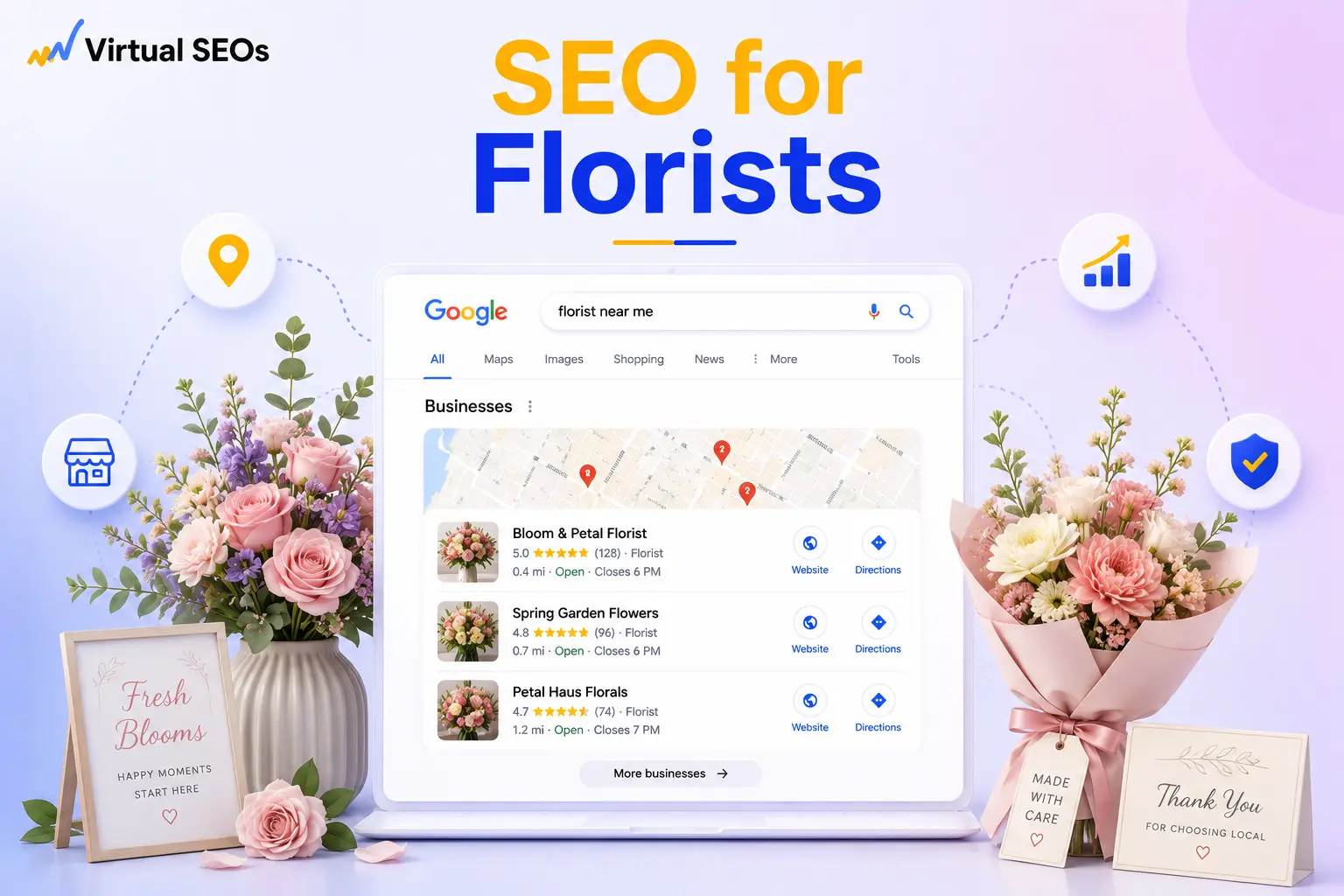
Unlike SEO for most other small businesses, florist SEO leans heavily local. A huge share of florist searches are “near me” or city specific, and Google typically answers them with the Local Pack (the map and three business listings) rather than standard organic results.
That means your Google Business Profile often matters as much as your website, sometimes more.
Why Florist SEO Works Differently Than Other Industries
A few things make the floral industry unusual from an SEO standpoint, and understanding them changes how you should prioritize your time.
It’s overwhelmingly local. Someone searching “florist near me” isn’t comparing you to a shop in another state. They’re comparing you to the three or four shops within a few miles. Ranking well locally matters more than ranking well nationally.
Demand is seasonal and spiky. Valentine’s Day, Mother’s Day, and graduation season can each generate a huge share of annual revenue in a short window. SEO work needs to happen well before these dates, since Google doesn’t index and rank new pages instantly.
You’re competing against national relay networks and big box retailers. Order gathering networks (which route online orders to a local florist and take a commission), grocery store flower counters, and subscription box services all compete for the same searches, often with far bigger marketing budgets.
Your genuine advantages, such as locally arranged flowers, same day fulfillment without a courier handoff, and a real person who answers the phone, need to be visible in your SEO, not just discovered after someone orders.
The audience splits into distinct buyer types. Everyday and sympathy buyers, wedding clients, and corporate accounts search very differently and expect different content, so a one size fits all approach to keywords and pages leaves opportunity on the table.
What Florist Customers Actually Want
Before writing a single page, it helps to separate florist related searches into intent categories, because the same keyword can mean different things depending on the words around it.
| Search Intent | Example Searches | What the Searcher Wants |
|---|---|---|
| Local / Transactional | “florist near me,” “same day flower delivery [city],” “flower shop open now” | To find and order from a nearby florist immediately |
| Commercial Investigation | “best wedding florist in [city],” “top rated florist near me,” “florist reviews” | To compare a few local options before deciding |
| Navigational | “[Your Shop Name] hours,” “[Your Shop Name] delivery” | To find your specific business’s info |
| Informational | “how to keep flowers fresh longer,” “what flowers mean love,” “when to order wedding flowers” | To learn something, often before they’re ready to buy |
Most florist websites focus only on the first two categories and ignore informational content entirely, which is a mistake.
Informational content builds trust, earns backlinks, keeps visitors on your site longer, and often ranks for the exact question a future wedding or event client is asking six months before they book.
A well optimized website needs pages for all four intents, weighted toward local and commercial since that’s where the revenue is.
Keyword Research for Florists
Good florist keyword research goes beyond stuffing “florist” and your city into a page. Customers describe their need in different ways depending on the occasion, so your keyword list should be organized by buyer type, not just by search volume.
Core service keywords
| florist in [city] | flower shop in [city] | flower delivery [city] |
| same day flower delivery [city/zip] | flower shop near me | local florist near me |
| best florist in [city] | 24 hour flower delivery | flower delivery service near me |
| cheap flower delivery [city] | flower shop open near me | next day flower delivery |
Occasion driven keywords
| funeral flowers [city] | sympathy flower delivery | funeral flower arrangements |
| get well flowers | birthday flower delivery | anniversary flowers |
| new baby flowers | thank you flowers delivery | congratulations flowers |
| housewarming flowers |
Seasonal keywords
| Valentine’s Day flowers [city] | Mother’s Day flower delivery | prom corsages [city] |
| homecoming mums | Christmas centerpieces | Thanksgiving centerpieces |
| graduation flowers delivery | Easter flower arrangements | holiday flower delivery [city] |
Wedding and event keywords
| wedding florist [city] | bridal bouquet designer | wedding centerpieces [city] |
| event florist near me | wedding flower packages | destination wedding florist |
| elopement flowers | bridesmaid bouquets |
Corporate keywords
| office flower delivery | corporate gift flowers | lobby arrangements [city] |
| corporate event florist | business flower subscription |
Informational keywords
| how long do roses last | how to keep cut flowers fresh | what flowers are in season in [month] |
| meaning of different flowers | how to make a bouquet last longer | what flowers to send for a funeral |
| how far in advance to order wedding flowers | best flowers for each season |
Google Business Profile Optimization for Florists
If you only have time to do one thing from this guide, do this one. For florists, the Google Business Profile (GBP), the listing that shows up with the map, star rating, hours, and photos, usually drives more calls and orders than the website itself, because it’s what Google shows first for local searches.
Step 1: Get the basics exactly right
- Business name: Use your real business name only. Don’t stuff keywords like “Best Florist [City]” into the name field. This violates Google’s guidelines and can get your listing suspended.
- Categories: Set “Florist” as your primary category. Add accurate secondary categories like “Wedding Florist,” “Flower Delivery Service,” or “Funeral Service” only if you genuinely offer them.
- NAP consistency: Your Name, Address, and Phone number must match exactly across your website, GBP, and every directory (Yelp, Facebook, wedding directories, etc.). Inconsistent NAP data is one of the most common reasons local rankings stall.
Step 2: Fill out every available field
Service areas, business description, opening and holiday hours, products, and services should all be completed.
An incomplete profile signals lower authority to Google and gives customers less reason to trust you.
Step 3: Add photos consistently
Photos are one of the highest impact, lowest effort things you can do. Upload real photos of arrangements, your storefront, your workspace, and your team, not stock images.
Name image files descriptively before uploading (for example, “valentines-day-rose-bouquet-denver.jpg” instead of “IMG_4821.jpg”) to reinforce relevance.
Step 4: Post regularly and answer questions
Use the GBP Posts feature for seasonal offers, new arrangements, and holidays. Seed the Q&A section yourself with the questions customers actually ask, such as same day cutoff times, delivery radius, whether you handle funeral coordination, and how wedding consultations work.
Step 5: Actively manage reviews
Reviews are a major local ranking factor and, for florists especially, a major conversion factor. People choosing a wedding or funeral florist read reviews carefully before trusting a stranger with something emotional.
Ask every satisfied customer for a review, respond to all reviews (positive and negative) professionally, and never buy fake reviews, since Google actively penalizes this.
On Page SEO for Florists
Your website’s job is to convince both Google and the visitor that you’re the right florist for their specific need. That means going beyond a single homepage.
Build separate pages for separate buyer types
A single “Our Services” page trying to rank for weddings, sympathy, and everyday delivery all at once rarely ranks well for any of them. Instead, build dedicated pages such as:
- Wedding flowers / wedding florist [city]
- Sympathy and funeral flowers
- Same day flower delivery
- Corporate and event flowers
- Flowers by occasion (birthdays, anniversaries, get well)
Each page should have its own title tag, H1, and content focused on that specific need, including practical details customers actually want, like delivery cutoff times, pricing ranges, and what to expect from a consultation.
Get the on page structure right
- Title tags: Include your primary keyword and city, for example “Wedding Florist in Austin, TX | [Shop Name],” and keep it under roughly 60 characters.
- H1: One clear, descriptive heading per page that matches search intent.
- Meta description: A genuine, click worthy summary, not a keyword list.
- Image alt text: Describe the actual image (“white peony and eucalyptus bridal bouquet”) rather than stuffing keywords.
- Internal links: Link your blog posts to relevant service pages, and your service pages to each other, so both Google and visitors can navigate your offerings easily.
Use structured data (schema markup)
Schema markup is code added to your website that explicitly tells Google what your business is. It doesn’t change what visitors see, but it helps search engines understand and sometimes display extra details in results (star ratings, hours, price range).
For florists, LocalBusiness (or the more specific Florist schema type where supported), along with Review and FAQPage schema on relevant pages, is worth implementing.
This is a technical step most competitor guides skip entirely, and it’s one of the more reliable ways to stand out in search results without writing more content.
Don’t ignore mobile speed
A large share of florist searches, especially “near me” and same day searches, happen on a phone from someone in a hurry. If your site loads slowly on mobile, you lose that customer to a competitor before they even see your arrangements.
Compress images, avoid heavy unnecessary plugins, and test your site with Google’s Page Speed Insights periodically.
Content Strategy for Florists
Blogging isn’t about hitting a word count. It’s about answering the questions your future customers are already typing into Google, months before they’re ready to buy.
A content calendar built around your business’s real seasonality tends to outperform random topic ideas.
| Time of Year | Content Opportunity |
|---|---|
| January | “When to order wedding flowers: a month by month timeline” |
| Early February | “Valentine’s Day flower guide plus delivery cutoff dates” |
| March to April | “Best spring wedding flowers in [region]” |
| Early May | “Mother’s Day flower delivery guide” |
| June | “How to keep your bouquet fresh for a summer wedding” |
| September | “Fall centerpiece ideas for [city] weddings” |
| November | “Thanksgiving and holiday centerpiece inspiration” |
| December | “Christmas flower and greenery guide” |
| Year round | Flower care tips, flower meaning guides, local flower market and garden roundups |
Beyond the seasonal calendar, a few content formats are consistently underused by florist websites and represent real opportunity:
- Local guide content: “Best spring flower spots near [your town]” or “A guide to [your town]’s farmers markets” builds community relevance and earns local links.
- Care and education content: “How to keep cut roses fresh for two weeks” answers a genuinely common question and tends to earn organic backlinks from other sites.
- Comparison and decision content: “How to choose your wedding flowers by season and budget” helps a hesitant buyer move toward booking.
- FAQ style pages: Direct, snippet friendly answers to real customer questions (delivery radius, same day cutoffs, how far in advance to book a wedding) often win Google’s featured snippet box.
Building Local Authority and Backlinks for Florists
Backlinks, meaning other websites linking to yours, remain one of the strongest trust signals in SEO, but for a local business like a florist, the type of link matters more than sheer volume.
- Wedding and event directories: Listings on platforms couples actually browse (The Knot, WeddingWire, local wedding directories) build both referral traffic and authority.
- Local press and community sites: Local news coverage, “best of [city]” roundups, and chamber of commerce listings are genuinely valuable and realistic to earn.
- Supplier and partner links: Wedding planners, event venues, and funeral homes you regularly work with may be willing to link to you as a recommended vendor.
- Sponsorships and community involvement: Sponsoring a local event or charity often comes with a link from the event’s website, a natural, low cost way to build authority while supporting your community.
Technical SEO Basics Every Florist Should Know
“Technical SEO” sounds intimidating, but for a florist website it boils down to a handful of practical checks:
- HTTPS: Your site should use a secure connection (the padlock icon in the browser). Most modern hosting includes this by default; if yours doesn’t, it’s worth fixing immediately.
- Mobile friendliness: Your site should look and function well on a phone, not just a desktop.
- Site speed: Pages should load in a few seconds, not ten. Slow loading product and arrangement pages with unoptimized images are a common culprit.
- Clean site structure: Customers (and Google) should be able to reach any page within a few clicks from the homepage. Occasion pages, service pages, and blog posts should all be linked from logical navigation.
- No broken links or duplicate pages: Especially common on florist sites that have rebuilt product catalogs multiple times over the years.
Reviews and Reputation: The Trust Layer of Florist SEO
Because floral purchases are often tied to emotional moments, such as weddings, funerals, apologies, and celebrations, trust plays an outsized role in whether someone actually clicks “order” after finding you. Reviews influence both your local rankings and your conversion rate.
A few practical habits make a real difference:
- Ask for a review right after a successful delivery or pickup, when the experience is fresh.
- Make it easy. Send a direct link to your Google review page via text or email.
- Respond to every review, including negative ones, calmly and professionally; how you handle criticism is itself a trust signal to future customers reading it.
- Never incentivize or fabricate reviews. Google can detect patterns, and this risks your entire listing.
Are You Making These Common Florist SEO Mistakes?
- Optimizing only the homepage instead of building dedicated pages for weddings, sympathy, and everyday orders.
- Ignoring the Google Business Profile after the initial setup. Stale profiles with no recent photos or posts lose visibility over time.
- Inconsistent business information across directories, which confuses Google about which listing to trust.
- Keyword stuffing page titles (“Best Cheap Florist Flower Delivery Flowers Near Me [City]”) instead of writing naturally for the reader.
- Publishing content without a seasonal plan, missing the weeks long lead time Google needs to index and rank pages before a holiday rush.
- Buying or exchanging fake reviews, which risks the entire profile being suspended.
- Neglecting mobile speed, losing urgent same day searchers to faster loading competitors.
How Long Does Florist SEO Take?
SEO is not instant. For a competitive local market, meaningful improvement in local pack visibility typically takes a few months of consistent work, and broader organic content can take longer to mature and rank.
No legitimate agency or consultant can honestly guarantee a number one ranking or a specific timeline; claims like that are a red flag, not a selling point.
Instead of chasing a single ranking position, track metrics that actually reflect business impact:
- Google Business Profile actions: calls, website clicks, and direction requests from your GBP dashboard
- Local pack visibility: whether you appear in the map results for your priority searches
- Organic website traffic, especially to occasion and service pages, via Google Search Console or Google Analytics
- Keyword rankings for your priority local and occasion terms over time
- Conversion rate: how many website visitors actually place an order or submit a wedding inquiry
DIY SEO vs. Hiring an SEO Agency for Florists
Many florists start SEO on their own, which is entirely reasonable for the fundamentals (claiming and completing your Google Business Profile, requesting reviews, basic on page fixes). Where it gets harder is sustaining it.
Consistent content publishing, technical fixes, schema markup, and link building all take ongoing time that’s hard to find while running a shop, especially during peak seasons when you’re busiest fulfilling orders, not writing blog posts.
| DIY SEO | Hiring SEO Help | |
|---|---|---|
| Best for | Basic GBP setup, review requests, small local shops with time to spare | Shops wanting consistent growth without the time cost, or competing in a crowded market |
| Time investment | High, ongoing, especially around technical and content work | Low on your end, delegated to specialists |
| Learning curve | Real. Schema markup, technical fixes, and keyword strategy take time to learn well | None. You get expertise on day one |
| Cost | Mostly your own time, plus tool subscriptions | Ongoing service fee, but scoped to your budget and needs |
| Risk | Slower progress, or costly mistakes (like keyword stuffing your business name) | Lower, if the provider is transparent and experienced |
If you decide the ongoing workload of content, technical fixes, local citations, and link building is more than you have time for, that’s exactly where a dedicated SEO support model helps.
Local SEO service focuses specifically on Google Business Profile optimization and local visibility for businesses like flower shops, while the broader SEO Virtual Assistant lets you bring on dedicated, affordable support for exactly the tasks you don’t have time for, without hiring a full in-house team.
It’s worth exploring if you’d rather spend your time on arrangements and customers than on schema markup and keyword spreadsheets.
Frequently Asked Questions
Do florists really need SEO, or is social media enough?
Social media builds brand awareness and can drive some traffic, but most people searching for a florist are doing so with clear buying intent on Google, using searches like “florist near me” or “wedding florist [city],” and SEO is what makes sure you’re found in that moment. The two work best together, not as substitutes for each other.
How much does SEO cost for a florist?
Costs vary widely depending on your market’s competitiveness and how much work you take on yourself versus outsource.
Basic Google Business Profile optimization and review management can be done at low cost with mostly your own time; ongoing content, technical SEO, and link building through an agency or freelancer typically run as a monthly service fee scoped to your goals.
How long until I see results from SEO?
Local visibility improvements (like Google Business Profile actions) can show progress within a couple of months of consistent work, while broader organic rankings and content typically take longer to build momentum.
Be cautious of anyone promising a specific ranking or guaranteed timeline.
What’s the single most important SEO task for a florist?
For most florists, a fully optimized and actively maintained Google Business Profile has the highest impact relative to effort, since local search results are dominated by the map pack for florist related searches.
Should I have separate pages for weddings, sympathy, and everyday flowers?
Yes. Each of these represents a different search intent and customer need, and a single page trying to cover all of them typically ranks worse for each individual topic than dedicated pages would.
Do I need a blog if I already have service pages?
A blog isn’t required, but it’s one of the most effective ways to capture informational searches (like care tips or “when to order wedding flowers”) that bring in future customers before they’re ready to book, and it gives you natural opportunities to earn backlinks and build topical authority.
Share

SEO Content Strategist
We are committed to providing quality services at competitive prices.


